
Clear tap water flowing from a modern stainless steel kitchen faucet in a residential home.
Most people assume that if their tap water looks clear and meets legal standards, it must be clean.
In reality, the picture is more complex.
Municipal water treatment plays an essential role in protecting public health, but it is not designed to remove every possible contaminant. It also cannot account for aging infrastructure or the unique conditions of individual homes. As a result, water that meets regulatory requirements can still contain substances many homeowners would be surprised to learn about.
Understanding what is actually in your tap water is the first step toward making informed decisions about your home and your family’s long-term exposure.
What’s in Tap Water Beyond H₂O
Tap water is more than just water. It is a mixture of naturally occurring minerals, treatment chemicals, and trace compounds that enter along the way from source to faucet.
Some of these substances are added intentionally, such as disinfectants used to control harmful bacteria. Others are byproducts of treatment processes or contaminants that enter water as it travels through pipes and distribution systems.
In general, these substances fall into a few broad categories:
- Disinfectants and disinfection byproducts
- Inorganic contaminants such as metals and minerals
- Industrial or synthetic compounds
- Naturally occurring elements influenced by local geology
While many of these are regulated, regulation does not necessarily mean elimination. The Environmental Protection Agency maintains a list of regulated drinking water contaminants here:
https://www.epa.gov/sdwa/drinking-water-contaminants
How Water Travels From the Source to Your Home
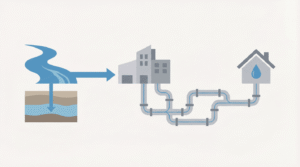
Illustration showing how drinking water moves from natural sources through treatment facilities and underground pipes to homes.
Drinking water follows a long and complex path before it reaches your faucet.
It typically begins at a source such as a river, lake, or underground aquifer. From there, it is treated at a municipal facility to reduce pathogens and improve safety. After treatment, water travels through miles of underground pipes, many of which were installed decades ago, before finally entering individual homes.
Along this journey, water can interact with:
- Aging or corroded pipes
- Local distribution infrastructure
- Materials used in service lines
- Household plumbing systems
Each stage introduces variables that can influence the final quality of the water at the tap. More information on the municipal water treatment process is available here:
https://www.epa.gov/water-research/drinking-water-treatment-process
Common Categories of Drinking Water Contaminants

Scientific visualization of invisible water contaminants, including molecular compounds and trace metals, suspended in water.
Disinfection Byproducts
Chemicals like chlorine and chloramine are commonly used to disinfect drinking water. When these disinfectants react with organic matter, they can form disinfection byproducts. These compounds are regulated, but they are still present in many municipal water systems. The EPA outlines these compounds here:
https://www.epa.gov/dwreginfo/disinfectants-and-disinfection-byproducts-rules
Metals
Metals such as lead, copper, and arsenic can enter drinking water through natural deposits or through corrosion in pipes and plumbing materials. Even homes with newer plumbing may be affected depending on the surrounding infrastructure. The EPA provides detailed information on lead in drinking water here:
https://www.epa.gov/ground-water-and-drinking-water/basic-information-about-lead-drinking-water
Industrial and Synthetic Compounds
Some compounds, including PFAS, originate from industrial processes and consumer products. These substances can persist in the environment and may be detected in treated drinking water long after their initial release. The EPA’s overview of PFAS in drinking water can be found here:
https://www.epa.gov/pfas/pfas-drinking-water
Many of these contaminants are invisible, odorless, and tasteless, making them difficult to detect without testing.
Why Meeting Standards Does Not Always Mean Problem-Free
Drinking water regulations are designed to protect public health at a population level. They balance safety, feasibility, and cost across entire communities.
They are not personalized.
They are not home-specific.
And they are not designed around cumulative exposure within individual households.
This is one reason neighboring homes can receive water from the same utility and still experience different water quality at the tap, particularly in areas with older infrastructure or mixed plumbing materials. The EPA explains how drinking water standards are set here:
https://www.epa.gov/sdwa/how-epa-regulates-drinking-water-contaminants
Why Many Filtration Approaches Fall Short
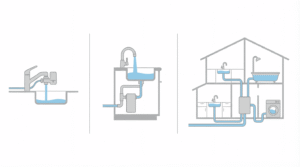
Diagram comparing single-faucet filtration, under-sink filtration, and whole-home water filtration coverage.
Not all filtration methods address water in the same way.
Single-faucet filters treat water at one point of use. Under-sink systems treat select fixtures. Whole-home filtration treats water before it reaches any tap in the house.
Each approach has trade-offs, and understanding the scope of filtration is just as important as understanding what a system is designed to reduce.
Water does not only affect drinking. It also affects bathing, cooking, laundry, and the surfaces your family interacts with every day.
Why Materials Matter in Water Systems
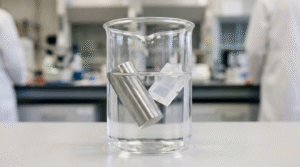
Stainless steel and plastic materials partially submerged in water inside a laboratory beaker.
The materials used in water systems play an important role in durability, longevity, and how systems interact with water over time.
Some materials are more resistant to corrosion, chemical interaction, and bacterial growth. Others may be lighter or less expensive, but behave differently under long-term exposure to water and changing conditions.
Understanding these material differences helps explain why some systems are designed for short-term convenience, while others are engineered for long-term performance.
The Most Important Step: Know Your Water
Water quality is not one-size-fits-all. It varies by location, water utility, infrastructure age, and even neighborhood.
Before considering solutions, the most important step is understanding what is actually in your local water supply.
Check your local water quality
Enter your ZIP code to view a personalized water quality report based on your local water system and publicly reported data:
https://purityhomeco.com/#get-my-report
Taking a Smarter Approach to Water Quality
Municipal water treatment provides a critical baseline of safety. For homeowners who want a deeper understanding of their water and how it affects their home, education is the logical starting point.
When you know what is in your water, you can make clearer and more confident decisions about how to address it.